

“Their brains lit up!” Most people will be familiar with the hot yellow and red blobs superimposed on beautifully high-resolution brain images to show brain activation. These images give the impression that the brain is switching modules on and off as needed to complete its arcane computations, but the typical blob is just a statistical contrast comparing groups or experimental conditions. In reality, the brain is brimming with activity everywhere, all the time. Even in the absence of any experimental task, there are dynamic fluctuations in metabolism all over the brain. Loads of research now supports the idea that these fluctuations are not just random noise, but rather that they carry information predictive of behavior and cognition.
The conventional way that neuroscientists have been thinking about these fluctuations is in terms of functional networks, which are composed of specialized nodes distributed throughout the brain. One of the more surprising findings that led to this network-architecture-thinking is that even during rest, when a participant is instructed to do nothing in particular, brain activity seems to be organized into networks. The time-course of activity of any small portion is highly correlated with the time-course of activity in other specific parts of the brain in very replicable patterns. For example, if you took a functional scan of your brain while laying in an MRI scanner for 10 minutes, I can predict with some confidence that the fluctuations in metabolism going on in your angular gyrus, way off towards the back and side of your brain, will be highly correlated with the fluctuations going on all the way on the other side of your brain, in your medial prefrontal cortex. These same networks that can be identified during rest also seem to show up during certain types of cognitive tasks. Scientists have mostly assumed that these networks of nodes in the brain have modular functions, and they use cognitive tasks to try to learn what those functions are.
The biggest technical limitation in the conventional analysis comes from the decision to correlate the full time series between two regions to establish their connectivity. This methodology has implications for how we interpret the signal. What the method misses are two critical questions about timing. First, does this functional connectivity stay stable, or does it vary over time? Second, does activity in the brain propagate or occur simultaneously? With our simple correlation analysis, we assume that the connectivity mostly stays the same and that within-network fluctuations of brain activity mostly occurs around the same time.
Neuroimagers are not blind to these assumptions and much work has gone towards discovering more about the dynamics of brain metabolism. There are diverse approaches, way beyond the scope that I want to cover, but the answers to our questions above are that network connectivity does seem to vary over time and there also seems to be some propagation of signals. The propagation of activation is what I want to focus on.
In 2015, Anish Mitra, along with Abraham Snyder, Tyler Blazey, and one of the living gods in the pantheon of neuroscience, Marcus Raichle, published work that looked at “lag structures” of functional activity. The idea was basically that instead of assuming that functional activity should be most correlated between two regions at the same sample in time, maybe we should also look at correlations that are offset by some number of samples. This idea is pretty bold. We know that neural activity propagates through the brain, but those signals occur on the order of milliseconds. The temporal resolution of a sample in functional MRI (fMRI) is a few orders of magnitude worse. But the situation is even worse than that! The physiological response that fMRI is sensitive to sluggishly follows neuronal metabolism about 4 to 10 seconds later. Basically, no one expected to see propagating neural activity moving so slowly. And yet, a number of groups have now observed this phenomenon.
I have the honored distinction of being the least talented member of one of these groups. We recently posted a manuscript on bioarxiv, which uses a type of cyclicity analysis to determine leader-follower relationships between regions in the brain. The method itself has some wonderful properties that make it useful, including the ability to find leader-follower patterns between regions without needing to assume some sort of specific and invariant time lag upfront. It works by relying on the oriented area between two time series. The most simplistic example I can think of is illustrated below. Imagine that there are two signals occurring in time:
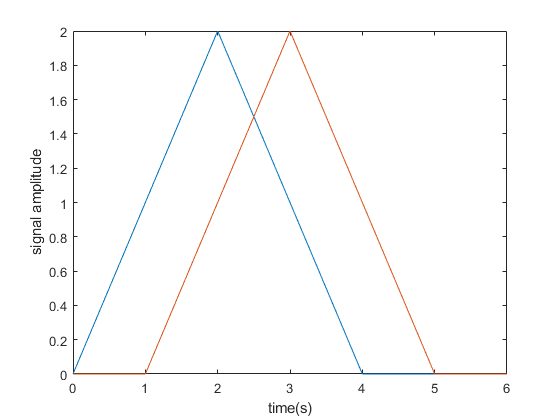
Hopefully, you agree with me that the orange signal follows the blue signal. We can plot these two signals against each other in a parametric plot:
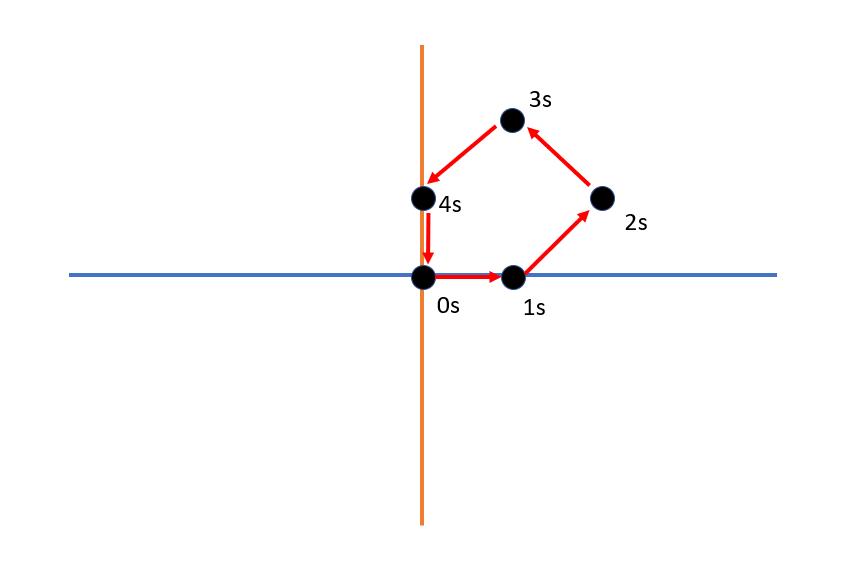
Now the axes represent the amplitude of the orange and blue signals (indicated by color), and time points are indicated as black dots in seconds. The clockwiseyness or counter-clockwiseyness of the plot tells you what degree one signal comes before or after the other signal. You can determine a metric of this clockwiseyness by calculating the enclosed oriented area if you happen to remember everything you learned in Calc III, …which I did not. Fortunately, the rest of my brilliant team members did, along with a good deal of other technical and mathematical expertise, and thus cyclicity analysis applied to fMRI data was born.
First, we analyzed data from participants during rest. We looked at data from the Human Connectome Project, which is an open dataset that anyone can look at and has been an amazing resource for progress in neuroscience. What we observed was quite exciting. We saw a definite direction of propagation that seemed to move backwards in space from parietal areas to more primary visual sensory regions. But it wasn’t until we looked at some task data that our jaws really dropped. The task we looked at was a social cognition task. In this task, the participants were shown short, 20-second video clips of shapes that either interacted in some way or moved randomly on the screen. After the clip, the participants were tasked to make a judgement about whether the shapes considered each other’s feelings and thoughts. As the participants watched the clips, we observed directional activity propagating from the primary visual areas in the back of the brain to the association areas of the parietal cortex. Then when the participants were asked to make a judgement, we saw a sharp switch in direction, with directional activity propagating from the association areas towards the visual areas, like we saw during the rest. To me, this pattern of activity strongly suggests that a direction of information flow in the brain is observable at relatively slow frequencies.
This idea of directional informational flow meshes well with an emerging alternative view of the physiology responsible for resting state networks. Remember, the conventional view is that networks are comprised of groups of modules, which are used to carry out specific types of tasks. The alternative, emerging view suggests that certain areas are correlated in time due to the phase and direction of propagating information. One of the major lines of research pointing to this interpretation is the innovative work of Daniel Margulies which characterizes functional connections in the cortex in terms of gradients. This work has found that rather than networks appearing to be isolated into distinct modules, correlations between areas seem to drop-off slowly in space. Further, the drop-off of correlation strength seems to follow a functional hierarchy.
The idea of hierarchy is not at all new to neuroscience. In fact, it is one of the essential ideas that neuroscientists use to think about the computations of the brain. For example, in the visual cortex, at the lower levels of the hierarchy, signals from the retina are combined to form impressions of edges and sharp contrasts. At the next level, these edges are merged into lines, then shapes, then more complex forms. Finally, in complex association areas, multiple sensory modalities are combined into higher level semantic features. Spatially, for the visual system, this computational flow starts in the very back of the brain and propagates forwards.
Putting these ideas together, functional brain networks could be thought of in terms of the direction and timing of flow, rather than as combinations of specialized modules. If you are paying attention to the outside world, then information flow may be propagating “forward,” starting with primary sensory regions, which process stimuli time-locked to real events in the outside world. We might predict that activations in sensory attention systems and primary sensory areas would be highly correlated in this “attend-outward” state and may become less correlated as they move through the hierarchy to association areas. If you are paying attention to the inside world and imagination, then information flow may be propagating “backward,” starting with the more complex association areas responsible for containing higher level semantic information, where processing is time-locked to a semantic representation, which then get projected backwards onto more primary sensory areas. For example, if you are asked to visually imagine a rabbit, you start with the idea of the rabbit as a concept, which then gets pushed to your sensory modalities where a visualization of the rabbit appears. We might predict that activations in the higher-level association areas would be highly correlated in this “attend-inward” state and may become less correlated as they move backward down the hierarchy to sensory areas. In fact, one of the dominant observations from functional brain networks is the anti-correlation of the dorsal attention network, which is seen most strongly when a participant is asked to attend to an external task, and the default-mode network, which is seen most strongly during self-referential, planning, or imagining tasks, which also seems to be the default for an idling mind.
With our cyclicity analysis we seem to observe this forward and backward propagation, and so I’ve become enamored with this hypothesis about brain organization. I’ve also maintained a consistent meditation practice now for a few years, and I am especially excited about the possibility of cyclicity analysis as a tool for better understanding and enriching meditation practice. The practice of meditation has been increasingly conceptualized in-terms of manipulating and controlling the direction and extent of hierarchical processing in the brain (or respectively the extent and level of prediction of the mind). This idea was very well explicated in a preprint that came out last year by Ruben Laukkonen and Heleen Slagter, which I think anyone interested in the neuroscience of meditation should read. The framework of meditation as an exercise in controlling hierarchical processing overlaps well with the idea of cyclicity analysis as a tool sensitive to hierarchical processing and opens many new avenues to test hypotheses about meditative practice.
First, I have read (but not yet experienced) from a number of sources that advanced meditators often describe a point where the core exercise of meditation, maintaining attention on the present and not mind-wandering, becomes effortless rather than effortful. Any novice meditator will relate with how difficult it is to prevent mind-wandering over an hour of meditation. I am now practiced enough that I have had some “good” meditation sessions, where I have meditated for a full hour without any substantial mind-wandering. I leave these sessions drenched in sweat. It feels like hard work. So personally, effortless meditation is very appealing. But also, as a neuroscientist, the idea of a sudden switch, where the task of meditation was hard but suddenly becomes effortless, is incredibly fascinating. I have spent a lot of time chewing on all-or-nothing mental phenomena like this — like the eureka moment, when some concept is suddenly clear and understood. I think that conceptualizing states as directional flow of information might be a candidate hypothesis for understanding this sudden switch. As I alluded to before, for some reason the “default-mode” of the brain, what the mind automatically does at rest, seems to be to imagine and plan — to linger in the future or the past. This requires processing information from high-level semantic representations backwards to their constituent sensory components. With enough intervention, controlling your brain to stop thinking about past and future and redirecting it to attend to the present, perhaps the plasticity of the brain allows it to eventually reset the default direction of flow. If my interpretation of our results is correct, we should be able to test this phenomenon and maybe even develop a general measure of expertise in meditation, by analyzing the direction of flow through cyclicity. I would expect that in an advanced meditator, compared to most individuals, I would observe the opposite direction of flow during meditation and maybe even during rest. A cyclicity-based, real-time metric may even be useful as a potential biofeedback signal, which may outperform current EEG-based methods that rely on frequency correlates of meditative states but often strongly overlap with other phenomena (e.g. general relaxation, sleepiness, or alertness). FMRI would be prohibitively expensive to commercialize for the purpose of biofeedback, but optical imaging systems may be viable. The cyclicity approach should be agnostic about the modality of measurement.
Another interesting potential application may be in predicting or training the vividness of sensory imagination. I admit that I haven’t seen many meditative practices that seek to improve the vividness of imagination, and this may be because most mainstream meditation practices spend time training the opposite direction of information flow. This is, admittedly, an even more far-fetched idea, but my thinking is that the conflict between bottom-up processing from incoming sensory processing and top-down processing from imagination might lead to imperfect and less vivid sensory representations. For a simple example of what I mean, think about how much easier it is to remember or imagine something with your eyes closed than with your eyes opened. If cyclicity can give us a metric of the flow of information, which corresponds to the strength of these outward-in or inward-out states, we might be able to use it as a predictor of the vividness of imagination. Training imagination like this does not seem nearly as in vogue as the traditional goals of meditation, but it strikes me as a tremendously useful skill. Maybe the top-down, backwards-moving cyclicity signal from association cortex to primary sensory areas could be used as a metric for biofeedback in order to train the vividness of memory and imagination.
Thinking of two primary directions of information flow in the brain is obviously simplistic, but I think that even this simplistic model of propagating information has a lot of potential for stimulating thought about networks and new experiments in cognitive neuroscience. Although it is in the very early stages of development, I think that the cyclicity analysis used in our preprint could be used for studying slower more state-based information flow in the brain. What do you think about this model of information processing in the brain? What other applications can you think of for cyclicity analysis in neuroscience and beyond?